

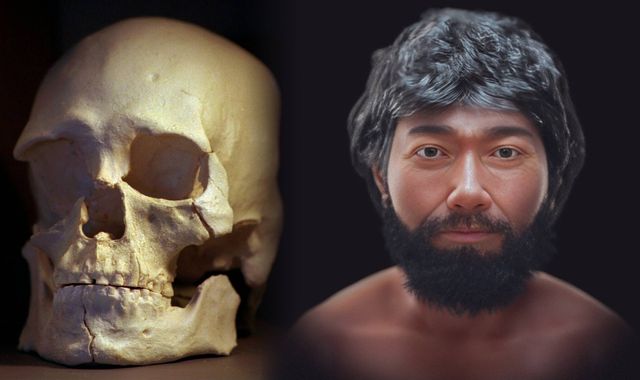
The living face of one of the most important human skeletons ever found in America can be seen for the first time in more than 8,000 years.
The Kennewick Man - named for the city in Washington State where his remains were discovered - was roughly 40 years old when he died in the early Holocene period.
Discovered on a bank of the Columbia River in 1996, his skeleton is one of the most complete ever found from this time in the Americas and has sparked debate about the peopling of the continent.
Now his living likeness can be revealed, after his skull was used to rebuild his features for a new study.
Cicero Moraes, lead author of the new paper, said the resulting face showed a "strong and resilient man" whose features revealed "a life marked by continuous physical effort and survival".
The reconstruction was achieved, he added, by combining "anatomical knowledge with statistical data".
He said: "First, the skull is analysed using known averages of soft-tissue thickness and anatomical guidelines to position key features such as the eyes, nose, lips, and ears.
"These references are based on large data sets, including medical imaging like CT scans.
"Next, the head of a digital donor is anatomically adapted to match the structure of the Kennewick skull, allowing the face to be shaped in a way that follows realistic biological patterns. The result is a basic facial approximation."
This process yields an objective face, based solely on the shape of the skull, without subjective features like hair or skin tone.
But a second, more-speculative version includes some of these elements, lending the recreation a more life-like aspect.
Mr Moraes said the hardship endured by the Kennewick Man was not only evident in his face, but in his bones.
He said: "Throughout his life, the individual sustained multiple physical traumas, including a small cranial depression, fractured ribs, a fracture in the right scapula, and a significant spear projectile wound where the stone point remained embedded in his right ilium."
The skeleton also showed evidence of significant dental wear, he said, and a condition called surfer's ear, which is caused by repeated exposure to cold water and characterised by bony growths in the ear canal.
Mr Moraes added: "While he suffered from mild osteoarthritis in places, most of his major injuries - such as the rib and pelvic fractures - were survived for years as they occurred during early adulthood.
"It is not known with certainty what led to his demise, but the injuries to the shoulder are identified as having occurred close to the time of death."
Read more:
Face of 75,000-year-old Neanderthal woman reconstructed
Scientists in Poland rebuild the face of 400-year-old 'vampire'
In life, the Kennewick Man would have been roughly 5ft 8in tall and weighed between 70 and 75kg. He would have survived on a diet of marine species and drank glacial meltwater.
Today, his skeleton comprises 350 bones and fragments.
Mr Moraes said the remains are considered "one of the most important human skeletons ever found in North America".
In particular, they've shone fresh light on the scientific debate about whether the earliest inhabitants of the Americas were "Palaeoindian" or "Palaeoamerican".
Advocates of the former position maintain that the first Americans are the ancestors of modern Native Americans, while their rivals assert they are unrelated, perhaps from an extinct Asian or European lineage.
But the Kennewick Man settled the question, according to a 2019 article by anthropologist Ann Kakaliouras, who wrote that the skeleton marked "the End of a non-Indian ancient North America".
Mr Moraes said: "The research on his remains has significantly expanded our understanding of the peopling of the continent and helped refine long-standing theories about early human migration in the Americas.
"Beyond scientific data, these studies have also allowed researchers to glimpse aspects of his everyday life - almost as if a small window to the past had been opened, giving us a rare opportunity to witness how he may have lived."
The study was published in the journal OrtogOnLineMag.

(c) Sky News 2026: Meet the Kennewick Man: Face of 'most important' ancient American revealed after 8,500 years
 Trump is not bluffing, Greenland situation is critical for Europe and NATO
 Iraq veterans living with 'ticking time bomb' after not receiving medical screening for deadly toxin exposure
 Rapper describes 'massacre' on Iran's streets - as supreme leader says thousands killed in protests
 'Experienced terrorist' killed by US strikes in Syria after deadly ambush left three Americans dead