


Jersey government's new Youth Justice Roadmap is putting prevention, early intervention and rehabilitation first.
The new 'child-first' approach aims to 'divert children away from the formal criminal justice system' at the earliest opportunity.
It is one of four promised outcomes of the long-awaited overhaul or 'reimagining' of youth justice in Jersey.
Ministers believe the roadmap will create a stronger, safer island community.
It pledges closer working between the Justice and Home Affairs department and Children's Services, as well as other key agencies.
Constable Richard Vibert, the island's Children and Families Minister and Assistant Minister for Justice and Home Affairs, told us:
" A child diverted from crime is not just a reduction in offending, it's a family strengthened, a victim restored and a safer island. I think that sums up what this is about, and it has to be successful."
Officials will follow measures to implement the new roadmap, and children and their families will be given more support to create positive home lives.
It will involve Parish Halls, States of Jersey Police, Honorary Police, Jersey Youth Service, and the Children, Young People, Education and Skills department. Constable Vibert said:
"Children that perhaps have just started some sort of minor activity - graffiti or low-level anti-social behaviour - in the first instance, the Youth Service would engage with them and try and find out why. It may be boredom. It may be that they are unhappy with life and family, and that is where early intervention is particularly important."
The government is focusing on preventing children from entering the justice system through 'universal prevention, targeted intervention and community development' and the response to criminal behaviour through 'enforcement, justice and rehabilitation and recovery'.
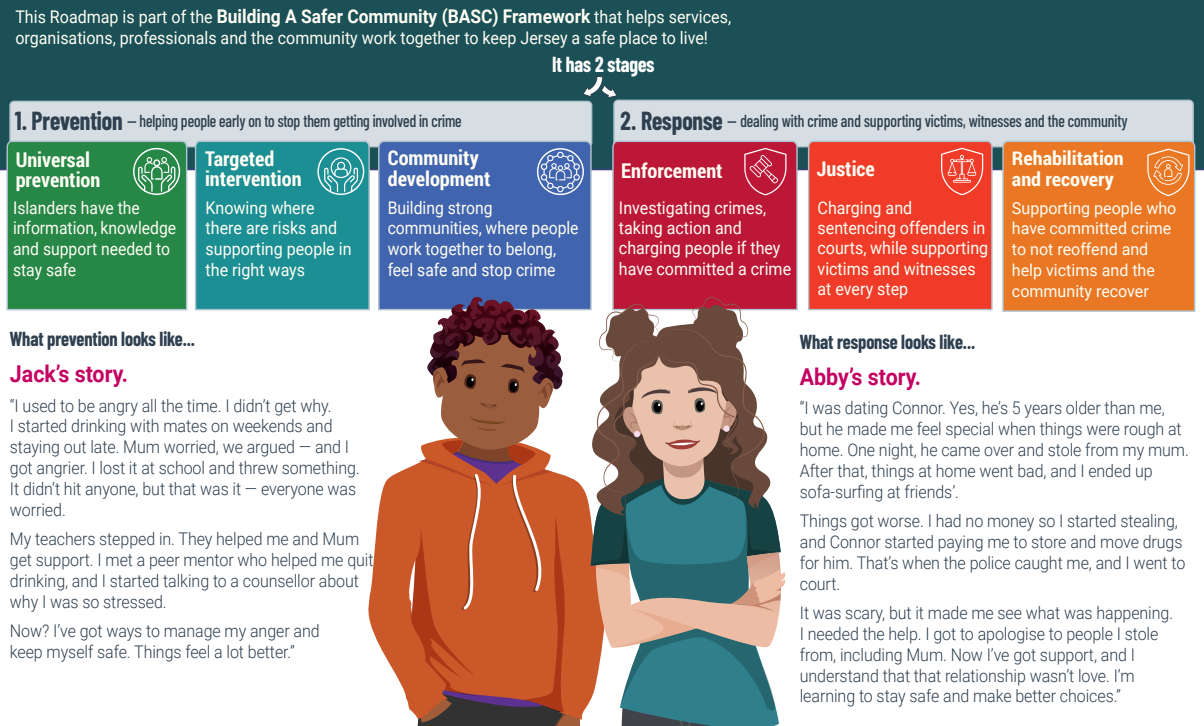
Other ideas include changing how children go through the courts. 'Timely' decision making will be prioritised for under 18s, in 'child-friendly' courts.
There will also be a review of the Youth Court Jurisdiction, 'sentencing innovation', Attorney General Guidelines and encouraging 'proportionate' crime reporting.
During detention, children will not be separated for long periods, and there will be a 'therapeutic' approach to education, training, health and care.
Jersey's minimum age of criminal responsibility is currently 10 years old; significantly younger than the UN Committee on the Rights of the Child recommended minimum age of 14.
The government says the prosecution of children under the age of 12 is rare here, although criminalising young children increases the likelihood of 'deeper justice system involvement'.
Constable Vibert says we have to recognise we might not have done things in the best way in the past.
"Some people think that a punitive regime is probably better, but I don't think that has ever been shown to be particularly effective.
"Once a child goes into the criminal justice system, sometimes they never leave it as an adult. I think that is the cycle that we have to break.
"Research is showing that more positive activity is more likely to have a positive effect. We may not have intervened as early as we should have in some cases.
"I think the link with Children's Services is particularly important, because it can often be children who feel family life has not been great who are sucked into or groomed into low level criminal activity to start with and that leading to greater crimes."
 Greenfield Centre
 4.7% increase in Jersey old age pension
 'No final decision' on planned Apple Crusher relocation
 DFDS Christmas timetable signed off... but still not published
 Opening of 'transformed' Departure Lounge weeks away
 Should the King Street apple crusher be relocated?
 Jersey Bulls restore away match livestream
 Jersey population stable but ageing as migration falls
 Ministers meet to discuss Channel Islands connectivity